Talk
Invisible Hands and the Everything Bagel
Why the best customer experiences are emergent; born from friction.
This is an adapted, written version of a talk I gave internally in October 2025, for CX Day, the industry’s annual observance for customer-experience work.

I’ve been thinking a lot about bagels, lately. Especially the everything bagel, everywhere, all at once. It contains the whole of existence; does it have clues to customer experience.
Indeed, it does. In one bite, I can taste the work of dozens of people who may never meet each other — and yet, together, they’ve created this moment (this experience) for me.
And here’s the thing: not one of them was thinking, ‘I’m going to make an amazing breakfast experience for Tony’ They were thinking about their own goals — profit, craft, efficiency, reputation. And yet, here I am, enjoying the fruits, er grains of their labor.
That’s the heart of my talk: the emergence of Customer Experience. It’s not the product of a single department, a single role, or a single decision. It’s the sum of many independent actions, incentives, and yes — even tensions — all pulling in different directions, yet somehow producing something worth savoring.
CX Is Everyone’s Job
Let’s rewind this bagel’s journey.
- A bakery owner sees a market opportunity.
- A chef perfects the recipe.
- A buyer sources flour from a farm hundreds of miles away.
- A baker gets up before dawn to make the dough.
- A marketer makes me want to try it.
- I show up, looking to buy a decent bagel at a fair price.
None of us were in the same room. None of us had the full picture. But together, we created this experience. And if anyone had phoned it in… I’d taste it.
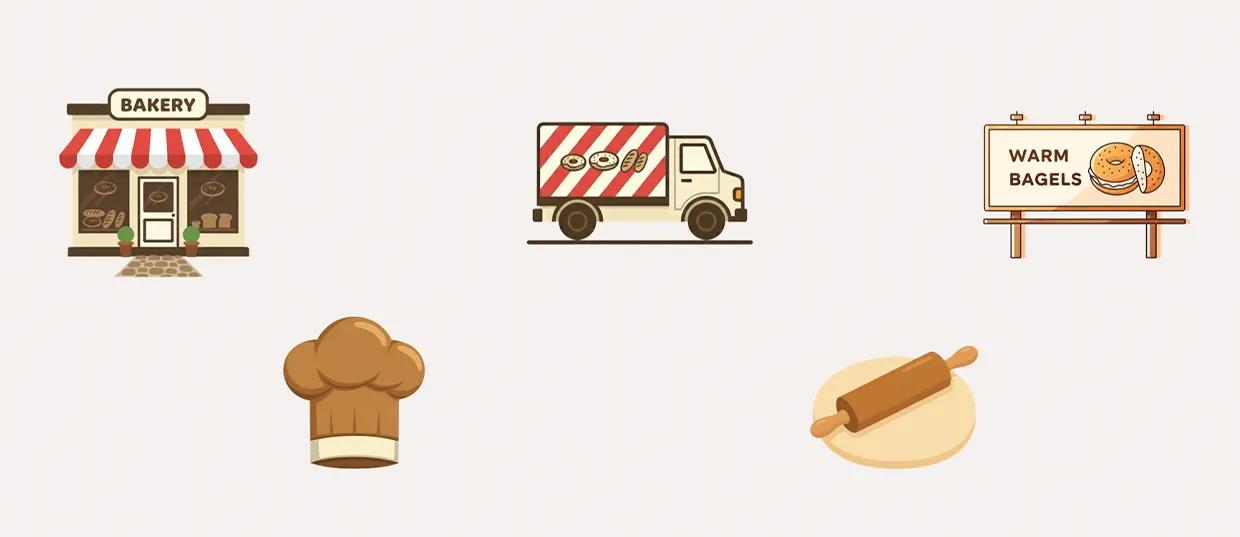
That’s Adam Smith’s invisible hand, holding a schmear.
The Push and Pull
Now, here’s the interesting part; this particular bagel didn’t happen because everyone agreed on everything. It happened because they didn’t.
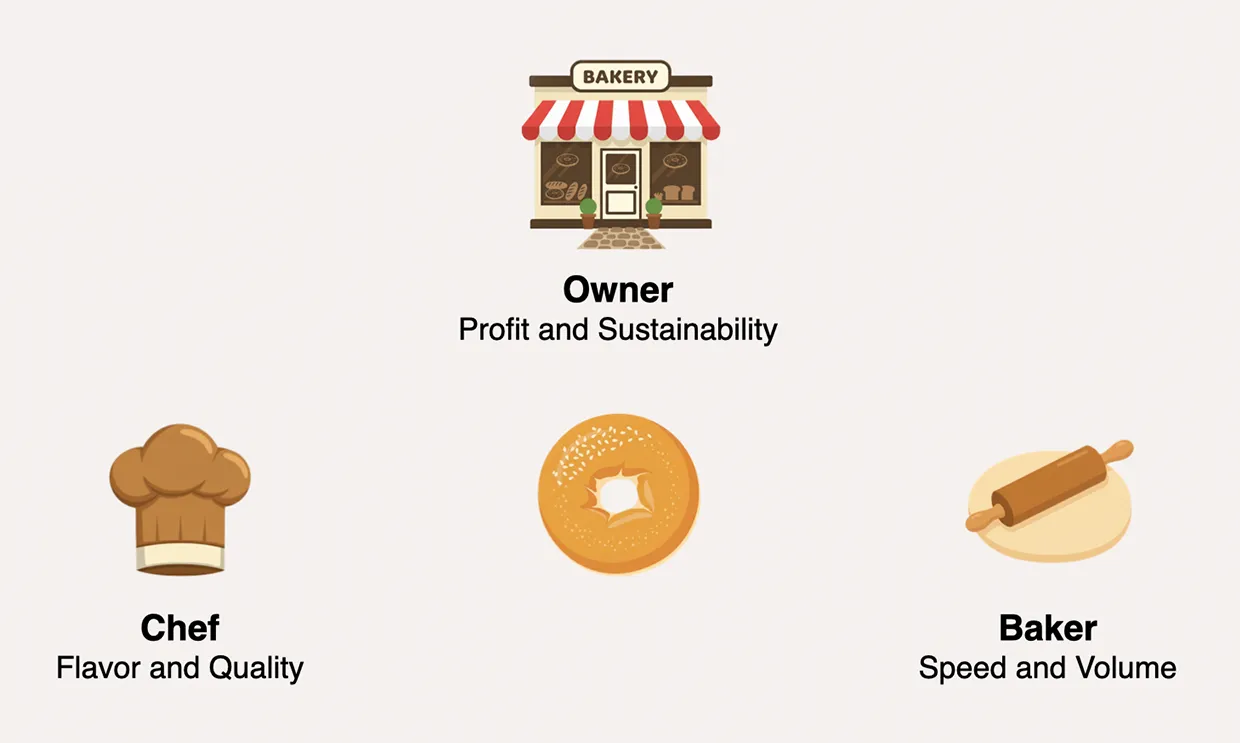
The owner cares about profit and sustainability. The chef obsesses over flavor and quality. The baker cares about speed and volume. Those goals genuinely compete.
It’s not harmony that makes this work. It’s the right kind of tension. The push and pull forces every one of them to make tradeoffs, and those tradeoffs, together, create balance.
And that’s where we’re not so different from a bakery.
Translating It to Product Development
We don’t make bagels where I work. We build connections, between people and the services they rely on. But the principle holds.
In telecom, we want to build something that attracts and keeps customers, at a price that gives them real value and keeps the business running. Three roles carry that weight, each with its own accountability:
- Product is the bakery owner: thinking about value, cost, timelines, profitability.
- Design is the chef: focused on usability and delight.
- Development is the baker: responsible for reliability, scalability, security.
Every team can contribute to every area. But only one team should be accountable for each one. That’s how you preserve healthy tension instead of chaos.
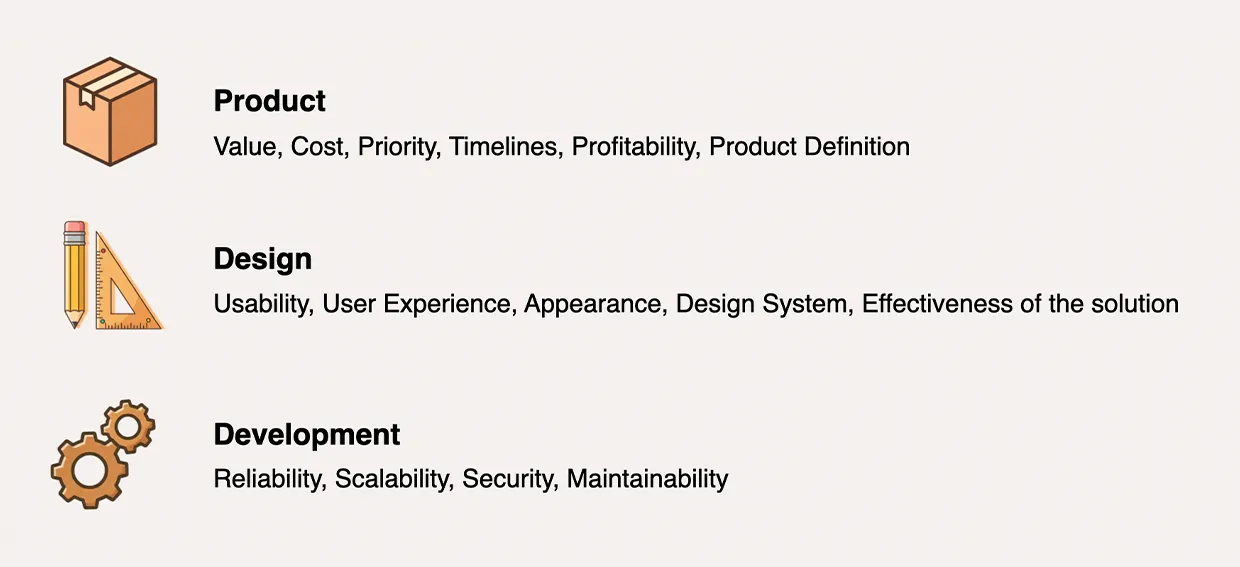
I’ve heard this called the tension triangle. I think of it as the recipe for success.
When It Doesn’t Go Well
But… what happens when someone goes off script? Most often because they’re in a hurry.

The owner starts writing recipes: over-prescriptive requirements that leave the chef nothing to solve. The baker skips the salt: an implementation detail that seems invisible until the customer tastes its absence.
When one role tries to fill another’s accountability, or a role gets undervalued, the balance collapses. When the business need isn’t clearly defined, or teams stay siloed, the customer feels it.
Where We’ve Found Success
Some of the time we keep the recipe intact by moving design upstream, before requirements harden into a spec.
On a handful of cross-functional programs, spanning account management, ordering, subscriptions, bundled entertainment, personalized recommendations, cart and checkout, and agent-support tooling, we’ve stepped in early to help reverse-engineer needs from wants. In practice, that means:
- Building rough, concrete models so people can point at something real instead of debating in the abstract.
- Fishing for dissent, actively, instead of waiting for it to surface on its own.
- Bringing in context from other initiatives across the company, so decisions dovetail instead of colliding later.
- Helping stakeholders unpack a prescriptive ask back down to the need underneath it.
Where We’re Still Growing
Every kitchen has its challenges. Two of ours:
We’re still figuring out how to balance exploratory design against everyday feature work, using the same pool of designers for both. And we’re working on tightening the handoff to development, so what we design still holds up once it’s in production. The design system, shared files, and closer partnership with developers are how we’re closing that gap.
The Next Bite
I held the bagel up one more time.

This is the product of many hands, many minds, and many motivations. So is our customer experience.
The tension you feel when working with other teams? That’s not a bug — it’s a feature. It’s the invisible hand shaping something better than any of us could make alone.
So: what’s one thing you can do to make the next bite, the next customer interaction, worth savoring?