civic
The Neighborhood Lab
Field-Testing AI Workflows in a Local Campaign
My neighbor decided to run for local office, and I offered to help. I had been building up a set of AI workflows, agents, prompting habits, a design process, and I wanted to field-test and refine them on something real, with real stakes and a real person depending on the result. His campaign became that lab. So the work was two things at once from the start. Help him win, and get sharper at how I actually use these tools.
The workflows I was refining
I started with campaign logos and color-palette options, driven with the CO-STAR prompting framework, and grew them into a full identity with type, color, and a small brand book. To support that work I built a campaign-advisor agent. It read through all of my notes and then interviewed my neighbor for about an hour to draw out his own thinking, and we used what it gathered to help codify his strategy. It worked with him to understand it, so the rest of the work could line up behind it. For research I had a separate perspective-analyzer agent I built that read a deep-research report on Douglas County voters and built a set of personas from it, which I then used to test the work against real points of view. For design I ran a process before drawing anything, a creative brief, competitive analysis, user research, and parallel design explorations. Agents and I sketched in the tightest loops I could manage, from a plain conversation to rough ASCII drawings to working HTML and CSS.
None of this was AI working while I watched. Each piece was a workflow I was building and correcting as I went, and I was the one setting the direction, making the calls, and editing what came back.
Research
- 1Deep research
- 2Persona development
Strategy
- 3Campaign brief
- 4Competitive analysisparallel subagents
- 5Creative brief
Design
- 6Information architecture
- 7Design ExplorationsExperience AgentAesthetics Agent
- 8Sketch refinement
Making public data public
Then my neighbor hit a wall that turned into the real project. He wanted property-tax numbers to show voters, went through the county’s official channel to get them, and was told a single canned report would cost around $400 and take someone about ten hours to produce. The data was public, but in practice it was locked away, scattered across different county sites and formats and awkward to pull together.
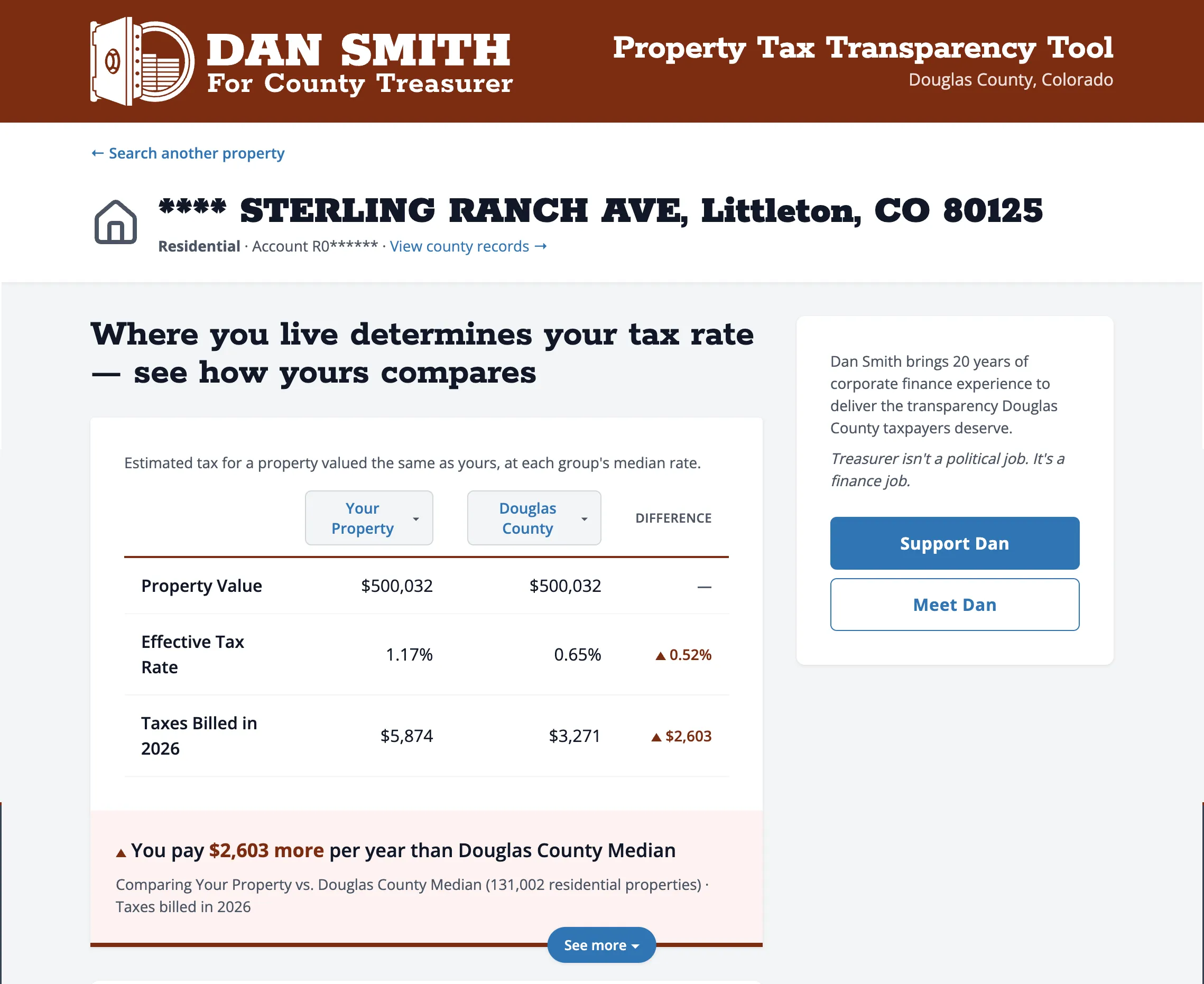
The first thing Dan and I did was prove it was possible. In a couple hours we found the sources, pulled and normalized the data, and stood up a rough working application, enough to show the idea held. That proof of concept became the reference for the real thing. I rebuilt it as a production tool that takes the county’s own assessor data, 157,557 properties across 615 tax districts, and makes it searchable, comparable, and explained in plain language, served as a fast static site over a real pipeline. Dan was soon pulling it up on a tablet to walk political insiders through their own numbers and getting great feedback.

The Speed Trap
For a tool people would trust with their own tax numbers, moving fast was worth nothing if the numbers were wrong. A mistake here is worse than no tool at all. It hands someone a confident, official-looking figure that happens to be false.
I felt uneasy putting numbers in front of people that I did not fully understand myself, so I dug in to validate them, and I used AI to check the data and show me the math. That is how I found the problem. One of the sources was serving old rates labeled as current, and for some properties that threw the result off by as much as 28 percent. I re-sourced the rates from the county’s own official document, rebuilt the dataset, and verified it against known properties until the numbers matched.
I want to be honest about what that does and does not prove. This is not a story about AI being unreliable. People make exactly this kind of mistake too, and I have made it myself. The real difference is friction and trust. With a person I have worked with, I know where they are strong and where I need to double-check, and there are natural moments in the work where a bad number gets caught before it ships. An agent moves faster, with fewer of those moments, and you can’t calibrate trust in an AI the way you do a teammate because its context is always shifting. The danger is not that AI is careless. It is that it removes the friction that usually saves us. Dan and another data-scientist volunteer loaded the same data independently and plotted the distributions, and that outside check mattered for the same reason.
What the lab taught me
The tool went live in the summer of 2026, and Dan and I are still keeping it current. It does the plain thing it set out to do, taking something public but locked away and handing it back to the people it belongs to, one address at a time.
What I came away with is simple to state and demanding to practice: AI is an amplifier, but the discipline belongs to the operator. Speed is easy, but friction is often where the real quality lives. The trap isn’t that AI fails, but that it produces polished answers so quickly it tempts you to stop thinking. Knowing when to slow down, double-check the math, and enforce the standard is still human work. That was the real point of the lab—and the craft is sharper for it.